Use rope specified for your retrieval setup and follow its manufacturer’s connection guidance. Length depends on the route to the water and the distance you plan to search. Condition and handling matter as much as length.
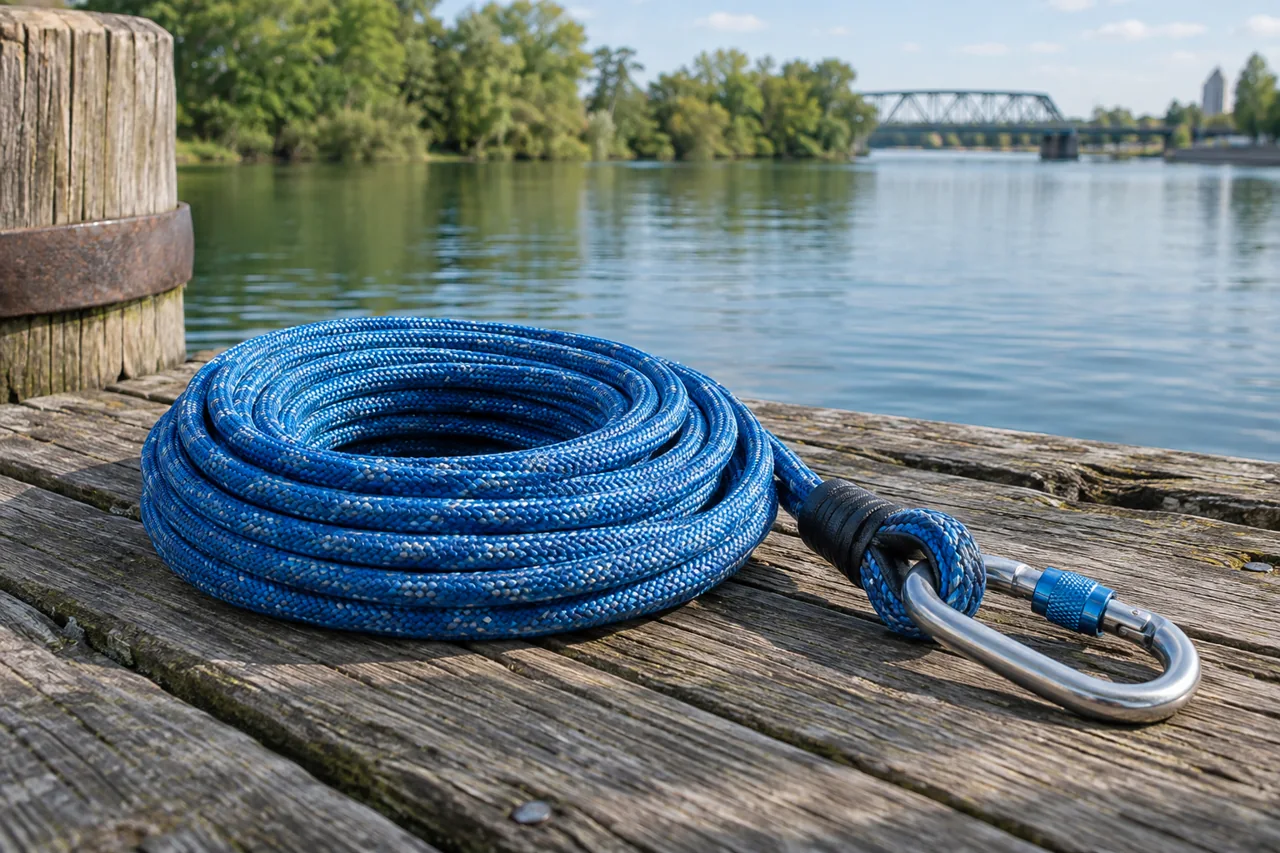
How much magnet fishing rope you can actually use
Rope must reach from your position to the search area with enough spare length for controlled handling and the recommended connections. Height, water depth and horizontal distance all matter. Avoid stretching a short rope to its limit just to reach one more spot.
Our rough rope planner estimates a straight-line route plus an allowance. It does not account for currents, underwater obstacles, knots or a safe working-load rating.
How to inspect rope, knot and magnet connection
Check cuts, abrasion, stiffness, damaged fibres and corrosion on metal components. Follow the maker’s retirement criteria. Do not assume a connector is suitable simply because it looks like climbing equipment.
Use the connection recommended for the magnet and rope. A knot can change rope strength. Threadlocker, where specified, secures threaded parts of the magnet; it does not secure the rope by itself.
How to handle a tensioned magnet fishing rope
Never loop a rope around a hand or attach it to your body. Keep others clear and avoid sudden yanks. If the magnet releases, the stored tension and movement can bring it back quickly. A lost magnet is preferable to a dangerous recovery attempt.
How to estimate usable magnet fishing rope length
Start with the permitted place where you will stand and the route back to you. Water depth alone does not describe the rope you need: the bank height, distance to the search area and the connection all use part of its length. Extra rope also needs space to lie without crossing a path or tangling around your feet.
The rope estimate tool is a planning aid. It does not check access, safe retrieval or the strength of a knot. Follow the magnet and rope manufacturers’ guidance for the actual setup. Retire damaged equipment according to that guidance rather than trying to cover worn areas.
Inspect the section near the magnet as well as the loose end. Look along the rope, not only at one obvious spot. If you cannot identify the rope or its condition is uncertain, replace it before the next outing.
Sources & further reading
Community questions inform the topics. Official sources support rules; manufacturer information is not a hands-on test.
- Brute Magnetics: equipment FAQManufacturer
- Reddit r/magnetfishing: updated FAQ discussion (21 July 2026)Community questions
- Reddit: community correction about tying a rope to your bodyCommunity caution